

Knee Cartilage
Demo Author One
Cartilage repair options for lasting joint health
A practical overview of cartilage repair, injection therapy, rehabilitation planning, and the clinical evidence that guides joint preservation care.

Condition · Hip
Pain, stiffness and a progressively shorter walking distance from cartilage wear in the hip joint. Assessed and treated at London Cartilage Clinic by Professor Paul Lee, with biological and joint-preserving options first and hip replacement when it is the right next step.
 Reviewed byProf Paul Lee MBBch, FRCS (Tr & Orth), PhDLast reviewed 1 May 2026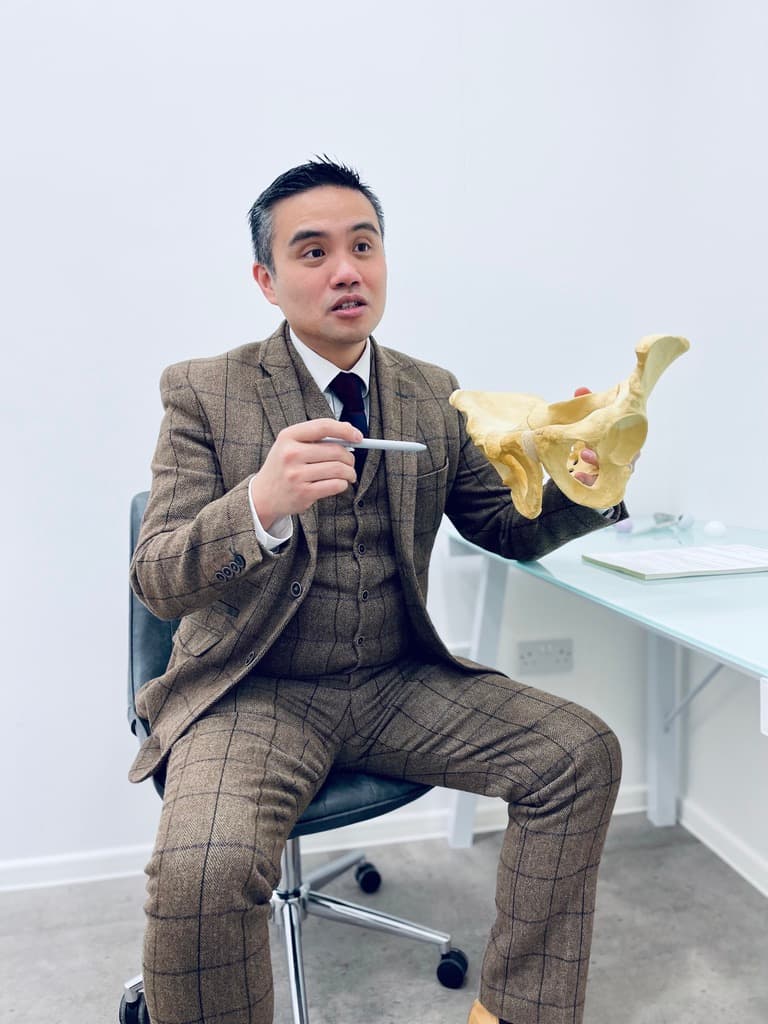
The hip is a ball-and-socket joint covered by a smooth layer of cartilage that allows the femoral head and acetabulum to glide against each other almost frictionlessly. Arthritis is the progressive wear of that cartilage.
Many patients live with hip arthritis for years before seeking specialist advice. The earlier we see you, the more options remain on the table.
Hip replacement is a well-proven operation, but it is a major operation with a finite implant lifespan. For many patients with hip arthritis, biological treatments and the right physiotherapy can reduce pain, restore function and delay or replace the need for surgery.
When hip arthritis is advanced and biological options are no longer enough, hip replacement led by Professor Paul Lee at the 5-star Weymouth Street Hospital is the right next step.

Take the readiness self-assessment, or book a consultation with Professor Paul Lee to walk through the full range of options for your hip arthritis.
You may have more options than you think
At London Cartilage Clinic we follow a structured clinical framework across four areas of treatment. Before recommending a single procedure, we assess which combination of approaches gives you the best outcome.
Protect what you have. Slow degeneration and manage symptoms.
Fix specific damage. Torn tissue, unstable joints, structural problems.
Rebuild lost tissue. Biological treatments that stimulate new growth.
When other options are exhausted. Joint replacement as a last resort.
Explore the full range of treatments available for your joint. Each hub page shows every option we offer, organised by clinical approach.
Led by Professor Paul Lee at the 5-star Weymouth Street Hospital. Muscle-sparing technique, patient-specific planning, and a published 0% safety record.
Read moreNine questions, around three minutes. A shared decision-making tool to frame a conversation with Professor Lee.
Read moreHarley Street consultations with surgery a short walk away at the 5-star Weymouth Street Hospital.
Read moreThe 0% safety record, SPAIRE technique citation and long-term implant survival data, reported plainly.
Read moreWhat to expect from the overnight stay through to long-term strength gains in the first year.
Read more
Hip arthritis is degeneration of the cartilage surfaces in the hip joint. The most common type is osteoarthritis, but post-traumatic, inflammatory and dysplastic patterns are also seen. As cartilage thins, the underlying bone is exposed, causing pain on movement, stiffness and a progressively shorter walking tolerance.
Hip arthritis often starts as groin or buttock pain, especially first thing in the morning or after sitting for a long time. Patients often report difficulty putting on socks and shoes, a shorter walking distance, and pain on the affected side when turning in bed.
Damaged cartilage does not regrow on its own, but the trajectory can be changed for many patients. Biological treatments such as ChondroFiller, stem-cell hip therapy, mFat and PRP can reduce pain and improve function. Tailored physiotherapy can offload the joint and protect what is left. None of these reverse advanced arthritis, but together they can delay or replace the need for hip replacement.
No. Hip replacement is the right answer when arthritis is advanced and biological options are no longer sufficient to support the life you want to live. For many patients, especially earlier in the disease, biological and joint-preserving treatments are a better first step. London Cartilage Clinic assesses every patient for these options before recommending replacement.
Yes. Professor Lee leads hip arthritis assessment and treatment at London Cartilage Clinic, including the full range of biological treatments as well as hip replacement when that becomes the right step.
An X-ray is the usual first step and is often enough to confirm the diagnosis and stage the arthritis. MRI may be requested if there is also suspected labral or soft-tissue damage, or if the picture on X-ray does not match the symptoms. You can bring any recent imaging to your consultation, and we can arrange imaging if you do not have any.
Still have more specific concerns?
Free Discovery CallLondon Cartilage Clinic
Clinical updates, cartilage treatment guidance, and recovery-focused articles from our specialist team.
A practical overview of cartilage repair, injection therapy, rehabilitation planning, and the clinical evidence that guides joint preservation care.
A practical overview of cartilage repair, injection therapy, rehabilitation planning, and the clinical evidence that guides joint preservation care.
A practical overview of cartilage repair, injection therapy, rehabilitation planning, and the clinical evidence that guides joint preservation care.