

Knee Cartilage
Demo Author One
Cartilage repair options for lasting joint health
A practical overview of cartilage repair, injection therapy, rehabilitation planning, and the clinical evidence that guides joint preservation care.

The London Cartilage Clinic provides treatment for kneecap injuries and kneecap related injuries that are market leading. We have a range of services to cater to a range of patients and circumstances.

Dislocation of the kneecap can be a result of damage to medial patellofemoral ligament (MPFL). The London Cartilage Clinic has the resources and expertise to repair this ligament and prevent future kneecap dislocations.
Learn More
A Chondromalacia affliction can result in the weakening of the cartilage behind the kneecap. This leads to an increased likelihood of tearing and dislocation. Fortunately, we have dedicated treatments to fix this problem.
Learn More
Surgery can be undertaken to remove small parts of the bone (or bones) in the knee joint, thereby allowing the patella to fit comfortably in its proper position. A knee osteotomy is considered a major procedure, so it’s important patients are fully aware of what is involved and the potential complications.
Learn More
Our specialist surgeons can complete a knee arthroplasty, where part of the kneecap and other bones in the joint may be replaced by artificial material. This is an effective treatment option for dislocated knees and osteoarthritis.
Learn More Reviewed byProf Paul Lee MBBch, FRCS (Tr & Orth), PhDLast reviewed 1 May 2026
The patella (kneecap) is a small, roughly triangular shaped bone that makes up part of the knee joint. It serves to protect the soft tissues and leg bones that are responsible for allowing the knee to bend. However, the kneecap also provides additional leverage for the leg muscles responsible for dictating knee motion. The back side of the patella is covered by a layer of cartilage which allows it to slide across the thighbone as the knee flexes.
A dislocated kneecap is where the patella is moved out of its usual place where the femur, tibia, and fibula meet. It is usually caused by an impact, such as from a fall or a vehicle collision. If you have a dislocated knee, you are likely to experience the following symptoms:
There are many options available when it comes to kneecap dislocation treatment which vary in their application. These range from kneecap dislocation surgery to targeted repair procedures and treatments to strengthen the tissue surrounding the patella. Regardless, a healthcare professional will first assess the severity of the dislocation to advise accordingly. The types of knee dislocation are medial, lateral, rotary, anterior, and posterior.
By adhering to the highest standards of surgical practices, we ensure our patients' kneecap dislocation recovery time is as short as possible. We are constantly seeking the best ways to treat cartilage damage throughout the body, but especially to key areas such as the kneecap. As such, we have refined our treatments and surgical approach over time to ensure we always deliver the best results and experience for our patients.

You may have more options than you think
At London Cartilage Clinic we follow a structured clinical framework across four areas of treatment. Before recommending a single procedure, we assess which combination of approaches gives you the best outcome.
Protect what you have. Slow degeneration and manage symptoms.
Fix specific damage. Torn tissue, unstable joints, structural problems.
Rebuild lost tissue. Biological treatments that stimulate new growth.
When other options are exhausted. Joint replacement as a last resort.
Explore the full range of treatments available for your joint. Each hub page shows every option we offer, organised by clinical approach.

We treat a variety of kneecap issues, including patellofemoral pain syndrome, chondromalacia patellae, dislocations, and fractures. Our treatments range from physiotherapy and bracing, key-hole STARRs internal bracing to complex surgical interventions, depending on the severity and nature of the condition.
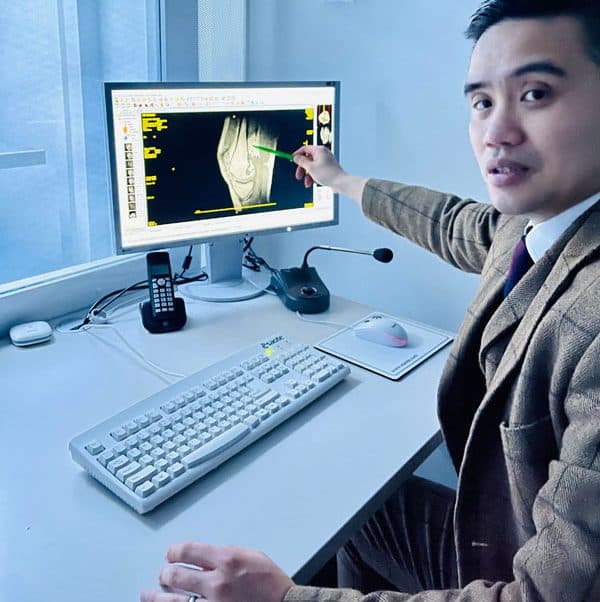
At the London Cartilage Clinic, the diagnosis of kneecap problems begins with a thorough clinical assessment, which includes a detailed review of the patient’s medical history and a comprehensive physical examination. To gain an accurate understanding of the condition, we employ advanced imaging technologies such as MRI and CT scans, which provide detailed insights into the state of the kneecap and the surrounding structures. A traditional X-ray can only provide a very limited information. For more complex cases, where standard imaging might not suffice, our clinic offers an innovative in-clinic procedure known as dynamic needle arthroscopy. This minimally invasive technique allows us to assess the internal structure of the knee joint in real time, providing us with a more precise and direct evaluation. This comprehensive approach ensures accurate diagnosis, which is critical for developing effective treatment plans tailored to each patient’s specific needs.
Treatment options vary based on the individual’s condition but can include physiotherapy, orthotics, pain management, and in some cases, surgery. Our focus is always on minimally invasive techniques and regenerative treatments to preserve as much natural structure and function as possible.
Still have more specific concerns?
Free Discovery CallLondon Cartilage Clinic
Clinical updates, cartilage treatment guidance, and recovery-focused articles from our specialist team.
A practical overview of cartilage repair, injection therapy, rehabilitation planning, and the clinical evidence that guides joint preservation care.
A practical overview of cartilage repair, injection therapy, rehabilitation planning, and the clinical evidence that guides joint preservation care.
A practical overview of cartilage repair, injection therapy, rehabilitation planning, and the clinical evidence that guides joint preservation care.